
Billing for procedural sedation in the emergency department
Billing procedural sedation in the emergency can be a pain. MSP rules and vague claim rejections can make it hard to know when it's okay and not okay to bill. This post will clarify when and how to bill procedural sedation and airway assessments for a patient.
*If you came here looking for info about local anesthesia like nerve blocks and trigger-point injections, we will cover that in a future post, which we will link to here when it's ready.
What fee codes are available to me
You bill sedation using the the following two fee codes:
- 01772: The fee code for doing the sedation. This is a time-based code, which pays per 15 minutes or part thereof. "Or part thereof" implies that 16 mins of prosed would count as 2 units.
- 13052: A pre-anesthetic evaluation fee for your airways assessment.
-
Modifiers can be billed in addition to your 01172 when they apply:
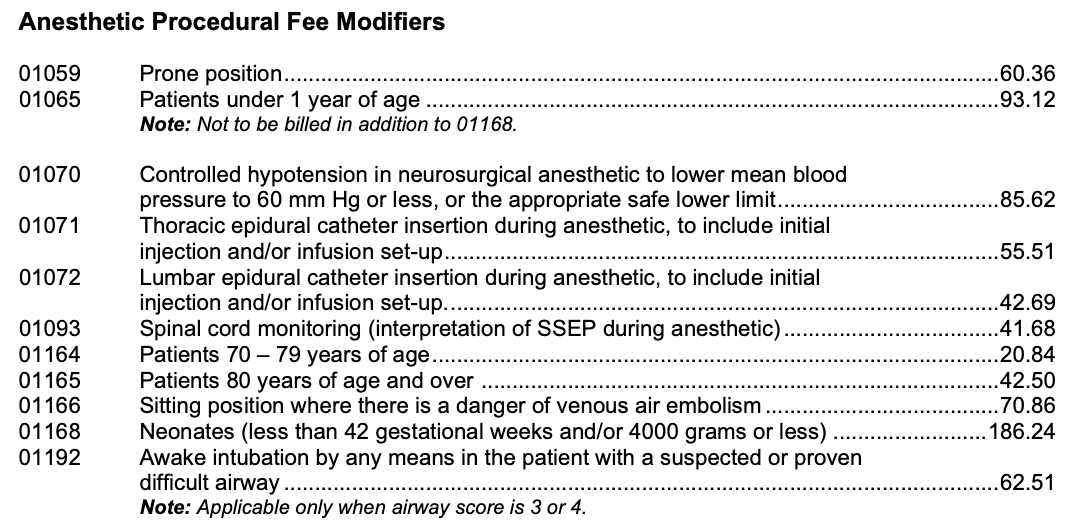
Procedural sedation modifiers
When can I bill procedural sedation
There are several scenarios in which you will do a procedural sedation. Some are straightforward to bill and others can get rejected.
1. You did the sedation for a colleague's procedure
This is the most straightforward scenario to bill for, and usually pays out without a problem. In this case you simply bill a unit of 01172 for every 15 mins (or part thereof) of your sedation.
If you did an airway assessment immediately before sedation, roll that time into your sedation time and just bill 01172s.
If you did the airway assessment but had to come back later to do the sedation, you can try to bill a 13052 for the airway assessment separate from the 01772, but the 13052 can be rejected sometimes, as explained below.
Why do my 13052s keep getting rejected?
The 13052 is meant for in-patients and out-patients. Whether a patient in the ED with another specialist performing the procedure qualifies as an in-patient is up for interpretation, which is why some adjudicators will accept and some will reject this code when billed by an emergency physician. See below for the MSP payment schedule language:

Obviously, if you actually left the ED to do an airway assessment on an in-patient for another service, then you can bill this. Just make sure to add a claim note that gives the adjudicator this additional context!
2. You did your own sedation
Most procedures that may require sedation will have a version of the fee code includes GA. An example would be a shoulder reduction, seen below in the MSP payment schedule:

So in the case of a shoulder reduction requiring GA you would not bill any sedations. You would simply bill the procedure that includes GA.
🤔 Question: If your colleague billed the procedure code that includes GA, but you did the sedation, can you bill for it?
Yes! They can bill the procedure with sedation and you can bill 01172s on the same patient.
There are procedures that may require GA and do not have a with GA version of the code. The best example is cardioversion (33025). If you had to sedate the patient yourself while also performing the cardioversion, you could try billing the following:
- 33025 for the cardioversion
- 01823 for you level code
- 01772 for your sedation
The chances of this being paid 100% are low. But why? Because of this rule from the anesthesia preamble:
The anesthetic procedural fee covers all services rendered by an anesthesiologist during the procedure, except those listed in the "anesthetic procedural fee modifier" and “acute pain management” sections of the fee schedule.
The implications here are two-fold.
- Firstly, it means that you yourself cannot bill both a procedure and sedation.
- It also means that you cannot bill a sedation and a level code on the same patient.
So your best chances to get this paid would be to do the following:
- Bill the 33025 (cardioversion) — will be paid
- Bill the 01823 (level 3) — will be paid
- Bill 01172 with a claim note stating something like "No anesthesiologist available [plus details as to why, e.g., single-coverage rural emerg]" — this might get paid. Depends on the adjudicator.
Yeah we know, the results are unpredictable. It essentially depends on the adjudicator you get. And even then, it can be clawed back at a later date. So whenever possible, it's best to get a colleague to do the sedation.